The Blue Star Flag

- The Blue Star Service Banner was designed and
patented in 1917 by World War I Army Capt. Robert L. Queissner of the 5th Ohio Infantry
who had two sons serving on the front line. It quickly became the unofficial symbol of a
child in the service.
- On Sept. 24, 1917, an Ohio congressman read the
following into the Congressional Record: “…The mayor of Cleveland, the Chamber
of Commerce and the governor of Ohio have adopted this service flag. The world should know
of those who give so much for liberty. The dearest thing in all the world to a father and
mother - their children.”
- During World War II, the Department of War issued
specifications on the manufacture of the flag as well as guidelines indicating when and by
whom the Service flag could be flown, or the Service Lapel button could be worn. The
Department of Defense updated the guidelines on December 1, 1967 with DoD Directive
1348.1, which implemented an Act of Congress authorizing a service flag and a service
lapel button (U.S.C. 179-182).
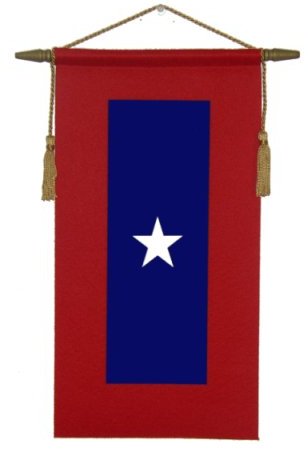
- The Blue Star Service Banner typically displayed in
windows is an 8.5 by 14-inch white field with a blue star(s) sewn onto a red banner. The
size may vary but should be in proportion to the size of the U.S. Flag.
- Today Blue Star Service Banners are displayed by
families who have a loved one serving in the US Armed Forces including the National Guard
and Reserves of all military departments The banner displayed in the front window of a
home shows a family’s pride in their loved one serving in the military, and reminds
others that preserving America’s freedom demands much.
- The blue star represents one family member serving in
the armed forces. A banner can have up to five stars, signifying that five members of that
family are currently in military uniform on active duty.
- If the individual symbolized is killed or dies while
serving the star representing that individual will have superimposed on it a gold star of
smaller size so that the blue forms a border. On flags displaying multiple stars,
including gold stars, when the flags are suspended as against a wall, the gold star(s)
will be to the right of, or above the blue star(s) in a place of honor nearest the staff.
- Blue Star Mothers and Gold Star Mothers organizations
were established during World War I and remain active today.
- Blue Star Service Banners, while widely used across
America during World Wars I and II, were not embraced during the Korean or Vietnam wars
with nearly the same enthusiasm.
- Those of us with family members serving in the US
Military Services have the exclusive privilege of displaying a Blue Star flag. We
ask all other families of US Service Members to join us.
- The Blue Star Flag is a symbol of both hope
and of grave concern. It symbolizes a pride in the commitment of America's youth and
reminder of the seriousness of the entire war effort. By displaying the Blue Star Flag in
the window, Americans who are so authorized can show their support and pride in the men
and women who are serving in the United States Military .

I am proud to display a flag with two stars honoring my son, a
Colonel in the US Army, and my daughter-in-law, a Lieutenant Colonel in the US Army.
Each of them has completed multiple tours in Iraq. My son recently
completed his third tour in Iraq and participated in the pull-out of US Forces
in northern Iraq.
I am privileged to display the flag
on the right to commemorate my status as a veteran, having served 20 years in the US Army.
PAUL F. COOK, CW3 (Ret), USA